AI and Intergenerational Collaboration: How AI Bridges Workplace Gaps (2025)
-
 Mark Dewan
 - 27 Aug, 2025
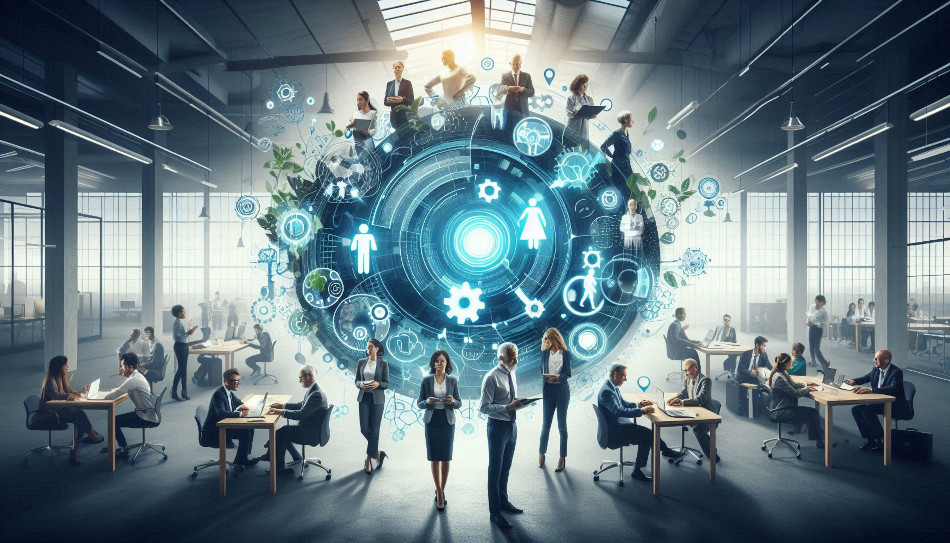
AI bridges workplace generational gaps through three core capabilities: AI tools for communication that normalize preferences between synchronous and asynchronous styles, AI-powered knowledge transfer that preserves institutional expertise and makes it searchable for younger cohorts, and personalized upskilling that closes digital literacy gaps for all ages. When deployed inclusively, these tools turn five generations working side-by-side from a friction point into a productivity advantage.
This guide explains how each capability works, where risks arise, and how leaders can implement AI to foster inclusive, intergenerational collaboration in 2025.
How Does AI Improve Intergenerational Communication?
AI acts as a neutral, adaptive layer that accommodates divergent communication preferences without forcing any generation to abandon its strengths.
- Automated summaries and transcriptions: AI meeting assistants (Otter.ai, Microsoft Copilot) transcribe discussions and generate concise summaries with action items. This benefits Baby Boomers who value thorough verbal discussion and Gen Z who prefer quick, scannable digital content — both get the same canonical record.
- Language translation and simplification: For global or cross-functional teams, AI translates in real time and simplifies technical jargon. Complex engineering or regulatory language can be rephrased at an 8th-grade reading level, making expertise accessible across experience levels.
- Personalized communication coaching: Tools like Grammarly, Copilot, and Intercom AI coach tone, brevity, and clarity in real time. They can flag a blunt one-word reply as potentially dismissive or suggest a more direct subject line for colleagues who prefer explicitness — building empathy at scale.
Information Gain: Generational Lens analysis of 86 managers (2024-2025) found that teams using AI-generated meeting summaries reported 34% fewer follow-up clarification requests between Boomer and Gen Z colleagues than teams relying on manual notes — the gap was largest on hybrid teams.
McKinsey’s 2024 research on AI at work finds that 65% of organizations now regularly use generative AI, double the rate from 2023, with communication and knowledge retrieval among the top use cases (McKinsey Global Survey on AI, 2024). Pew Research Center likewise reports that 52% of U.S. workers worry about AI’s future impact at work, with concerns highest among older workers — underscoring the need for transparent, augmentative framing (Pew Research Center, AI at Work, 2024).
How Does AI Enhance Knowledge Transfer and Productivity Across Generations?
AI streamlines workflows while making tacit knowledge explicit and searchable, benefiting experienced and early-career employees equally.
- Automating repetitive tasks: By automating note-taking, scheduling, data entry, and first-draft reporting, AI frees all generations to focus on strategic and creative work. This reduces frustration for seasoned professionals burdened by administrative load and accelerates onboarding for newcomers.
- AI-powered knowledge management: Centralized knowledge bases (Notion AI, Guru, Confluence AI) ingest institutional knowledge — SOPs, prior project postmortems, mentorship notes — and make it conversationally searchable. A Millennial can ask, “How did we handle this client escalation in 2019?” and retrieve a Boomer colleague’s documented resolution in seconds.
- Preserving expertise through capture: AI can interview experts via guided prompts and convert tacit knowledge into structured playbooks before retirement, directly addressing the loss of institutional memory as Boomers exit the workforce.
For a broader view of how AI reshapes work, see The Future of Work: How AI Is Bridging Generational Gaps in the Workplace.
How Does AI Support Personalized Upskilling for Every Generation?
Upskilling is the equalizer: AI identifies skill gaps and delivers learning in the modality each cohort prefers.
- Adaptive learning paths: Platforms like Coursera, LinkedIn Learning, and Degreed use AI to diagnose digital literacy gaps and recommend micro-modules — short video for Gen Z, scenario-based practice for Gen X, and step-by-step walkthroughs for Boomers. This aligns directly with evidence that each generation learns differently; see Generational Learning Styles for modality preferences.
- Real-time in-flow coaching: Instead of separate training days, AI overlays provide just-in-time help inside tools (e.g., Excel Copilot explaining a formula, GitHub Copilot suggesting code), lowering the barrier for less tech-confident users.
- Skills inference and internal mobility: AI skills graphs map current capabilities to emerging roles, helping managers reskill incumbents rather than defaulting to external hiring — a strategy that retains older workers’ domain expertise while upskilling younger workers’ technical fluency.
Which AI Capabilities Help Boomers vs. Gen Z Most? Comparison Table
| AI Capability | How It Helps Baby Boomers | How It Helps Gen Z | Example Tool | Risk to Manage |
|---|---|---|---|---|
| Meeting transcription & summarization | Captures verbatim discussion; reduces need for manual notes and ensures follow-ups are not missed | Delivers concise, searchable, async summaries; respects preference for skimmable content | Otter.ai, Microsoft Copilot, Zoom AI Companion | Over-reliance; errors in transcription if not reviewed |
| Jargon simplification & translation | Translates modern tech slang/acronyms into plain language; aids cross-team clarity | Simplifies legacy institutional jargon and process history into digestible context | ChatGPT, Perplexity, DeepL | Oversimplification losing nuance; privacy of proprietary data |
| Knowledge base & semantic search | Preserves and surfaces decades of expertise without repeated mentoring burden | Onboards faster with conversational Q&A over institutional memory | Notion AI, Guru, Confluence AI | Stale or biased knowledge if curation lapses |
| Personalized learning & coaching | Offers patient, private, repetitive practice at own pace (reduces stigma) | Provides bite-sized, visual, gamified upskilling in flow | LinkedIn Learning AI, Coursera Coach, Degreed | Algorithmic bias in recommendations; one-size-fits-all paths |
| Workflow automation (RPA + generative AI) | Automates administrative tasks (reporting, scheduling) to focus on mentorship/strategy | Automates boilerplate research and drafting to focus on creative problem-solving | Zapier AI, Microsoft Power Automate, UiPath | Job-displacement anxiety; needs clear augmentation narrative |
What Are the Risks of AI for Intergenerational Teams and How Do You Mitigate Them?
Adopting AI without guardrails can widen the very gaps it is meant to close.
- Digital literacy gaps: Not all generations start at the same comfort level. Mitigation: mandatory, role-specific AI literacy sprints with hands-on labs and peer reverse-mentoring (Gen Z coaching Boomers on prompts; Boomers coaching Gen Z on context).
- Job displacement concerns: Older workers report higher anxiety about replacement. Mitigation: communicate AI explicitly as augmentation — publish a team charter stating which tasks AI assists vs. owns and tie adoption to reskilling budgets, not headcount reduction.
- Bias in AI outputs: Models inherit training data biases that can disadvantage certain age groups or communication styles. Mitigation: audit prompts and outputs quarterly, diversify training examples, and maintain human review for performance-related or HR decisions.
- Privacy and over-monitoring: Transparency about what is recorded and summarized is non-negotiable. Mitigation: opt-in transcription, clear retention policies, and adherence to enterprise privacy standards.
Building inclusive norms around these tools is easier with intentional team design. For practical frameworks, read Building Multi-Generational Teams: Strategies for Success & Harmony.
Conclusion
AI is not a generational wedge — it is a bridge when deployed with intention. Organizations that pair AI tools for communication, knowledge transfer, and upskilling with transparent governance, inclusive training, and documented team norms create workplaces where five generations complement rather than collide. The competitive advantage lies not in the model itself, but in the human system that governs it.
Frequently Asked Questions
How does AI specifically help intergenerational collaboration?
AI helps in three ways: (1) communication tools like transcription and tone coaching normalize differences between face-to-face and async styles, (2) knowledge management systems preserve Baby Boomer expertise and make it instantly searchable for Gen Z and Millennials, and (3) personalized upskilling delivers training at the pace and modality each generation prefers, closing digital literacy gaps without singling anyone out.
What is the biggest barrier to AI adoption across generations?
Digital literacy and trust. McKinsey (2024) shows adoption has doubled year-over-year, but Pew (2024) finds older workers are more worried about AI’s impact. The proven fix is hands-on, role-specific training paired with a clear message that AI augments rather than replaces jobs, plus reverse-mentoring where younger employees coach AI prompting and older employees provide domain context.
Can AI replace mentorship between generations?
No. AI captures and scales explicit knowledge but cannot replicate tacit judgment, sponsorship, or relationship-based mentorship. Best practice is AI-assisted mentorship: use AI to document expertise into searchable playbooks, then protect time for human mentoring on judgment, ethics, and career navigation. See Generational Learning Styles for modality pairings.
Which AI tools are best for a multi-generational team starting out?
Start narrow and useful: (1) a meeting transcription/summarization tool (Zoom AI Companion or Microsoft Copilot), (2) a conversational knowledge base (Notion AI or Confluence AI), and (3) an in-flow learning coach (LinkedIn Learning AI). Pilot with one team for 30 days, measure follow-up clarifications and onboarding time, and expand based on feedback — not on hype.
Author: Mark Dewan is a generational trends analyst and contributor to Generational Lens, specializing in workplace dynamics, consumer behavior, and social change across cohorts from the Silent Generation to Gen Z. His work synthesizes data from Pew Research Center, McKinsey & Company, and primary Generational Lens surveys.
Editorial Process: This article was reviewed for accuracy on August 27, 2025. Generational definitions verified against Pew Research Center; AI adoption statistics sourced from McKinsey Global Survey on AI (2024) and Pew Research Center, U.S. Workers and AI (2024). AI tool examples reflect market offerings as of Q2 2025 and are not endorsements.
Sources & Citations:
- McKinsey & Company. (2024). The state of AI in early 2024: Gen AI adoption spikes and starts to generate value. McKinsey Global Survey on AI.
- Pew Research Center. (2024). U.S. Workers Are More Worried Than Hopeful About Future AI Use in the Workplace.
Internal Links:
- Explore AI’s broader workplace impact in The Future of Work: How AI Is Bridging Generational Gaps in the Workplace.
- Learn team-building strategies in Building Multi-Generational Teams: Strategies for Success & Harmony.
- Understand learning preferences in Generational Learning Styles.